Learn More About Small Scale Biodiesel Production

Printer-friendly versionSend to friendPDF version

Biodiesel is a great fuel!

It’s organic; it’s renewable; it gives more than it takes (net energy balance is 4.5:1); it’s cleaner burning than its petroleum counterpart, diesel, and biodiesel production is easy to learn. In short, it’s a compelling, domestically sourced, renewable, environmentally sustainable fuel alternative that should be in great demand.

So why is the industry in such turmoil? If you read the news reports and industry figures, it is evident that the commercial biodiesel production industry in the US is in the midst of being choked by a combination of government apathy, high priced feedstock, passive aggressive opposition from the Oil and Auto industries and a reliance on an outdated distribution and production model that needs to change. As a result, it’s not easy to find biodiesel at the pump; when you do, it’s priced at a premium to diesel, and the whole biodiesel production industry seems unhealthy.


That’s why, more than ever, small-scale biodiesel production makes sense!

Springboard Biodiesel has a long history of enabling profitable small scale biodiesel production systems throughout the US and internationally. Our customers use an array of feedstocks – soybean oil, canola oil, sunflower oil, beef tallow, restaurant grease, jatropha, etc - which all share the same fundamental characteristic: they are less expensive for the user than any other feedstock in his or her locale.

As you contemplate the viability of undertaking your own biodiesel production, the following pages will provide information on how to make/save money by making biodiesel in a small-scale biodiesel production system.


Step 1. What Will You Use as a Feedstock?

This is the critical question. What potential feedstocks can you use to produce biodiesel? If you have access to an inexpensive feedstock, and you use a well made, feedstock-flexible, small-scale biodiesel production system (BioPro™), you will make money with every gallon that you produce!

“What are considered suitable feedstocks for Biodiesel Production?” The short answer is that there are many potential feedstocks. We provide a partial list of potential oil seed crops below. There are 36 crops listed. In addition you can use fish oil, beef tallow, poultry fat and recycled vegetable oil (RVO). The latter is our favorite feedstock and is also the feedstock of choice for the vast majority of biodiesel producers.

“Where can I find my feedstock?” This is a question we receive every day. It’s a good question, but before answering it, let’s look at a few market statistics on general feedstock availability. We won’t regale you with USDA crop forecasts. Let’s face it, if you’re not a farmer, and you’re not growing canola, opium or some other oil seed crop, it’s going to be difficult to source your biodiesel feedstock from a harvested source. However, recycled feedstocks are produced in large volumes all over the world. In the US, there is a significant amount of available recycled vegetable oil (“RVO”) feedstock.

While there have not been enough recent studies on the overall availability of RVO, and most statistics are based off of a 1998 study of 30 metropolitan areas by George Wiltsee , the scope of the opportunity is substantial. Springboard has sized the market via multiple information sources and believes the following metrics accurately reflect US yellow grease and animal oil availability:

Recycled Vegetable/Animal Oil Market

Pounds of Yellow Grease per capita: 9 lbs
US population: 310,560,009
Total Yellow Grease: 2,752,335,595
Pounds/Gallon (avg): 7.5
Yellow grease gallons available: 366,978,079
420,000,000*
Available Grease (gallons): 782,850,071

*Tyson Chicken reports 2.3 billion pounds of fat produced in 2007. Springboard assumes the rest of the commercial food industry produces at least 50% additional pounds for a total of 3.15B pounds

Nearly 370 million gallons of grease (let alone a lot of poultry fat) means that there may well be a resource in your town. The best way to find out is go out and ask restaurant owners. Put your entrepreneurial hat on and see if you can’t entice a local restaurateur, to get into the clean energy game – maybe trade grease for some biodiesel; maybe give him/her some marketing materials that will let him let his customers know that he/she is thinking about the bigger picture.

So, let’s assume you’ve figured out the feedstock question; let’s take a look at the numbers. Just how attractive is this whole small-scale biodiesel production exercise?


If you get your feedstock for free (increasingly unusual), and your input costs roughly mirror ours (we’re guessing that your electricity and methanol are cheaper outside of CA), for every gallon you produce – excepting labor – you will save $1.97! (assuming a $3.00/gallon price for diesel) This is a pretax number, as the government requires that you pay both a federal and a state road tax. In California that’s $0.42/gallon, all in. So, if you make 9,000 gallons in a year, you’ll save almost $14K, net! In addition, you will also keep about 162,000 pounds of CO2 out of the air. Not to mention how good you’ll feel about the whole damn equation (cleaner burning, cheaper, domestically-made fuel!).

And what if, by chance, the price of oil increases? The chart below calculates the net return to you if you make biodiesel. It assumes you pay road taxes and do not claim any tax breaks, of which there still remain quite a few.


Step 2: How Do I Get Started? Identifying the Best Biodiesel Equipment


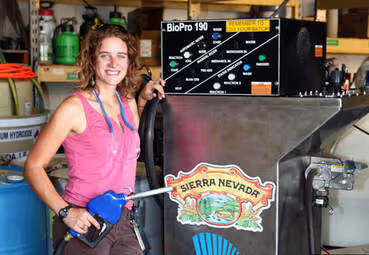
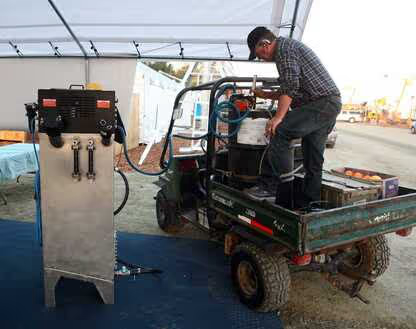
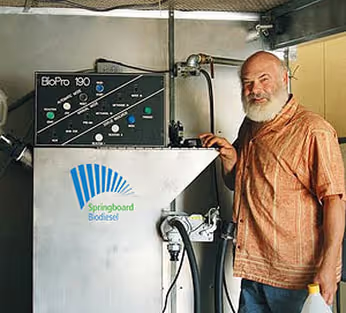
Springboard Biodiesel Small-Scale Biodiesel Processing Systems

biodiesel processor, biodiesel

Sure, we’re biased, but if you can kind find a better built, better performing, safer system that boasts patented design, an international CE mark and over 5 million gallons of annual installed capacity, go ahead and try it. We don’t think you will, and, more importantly, we know you will be happier starting with the best, rather than transitioning to us at a later date. Learn more about our Commercial Biodiesel Processors.


Step 3. Answering FAQs

Q: What do I do with the glycerin?

A: Each batch of biodiesel will produce a glycerin by-product equivalent to roughly 20% of your finished fuel. There are a number of strategies for dealing with this by-product. Its chemical profile will differ depending on your feedstock and your catalysts, but in general, we recommend mixing it with an equivalent amount of water (diluting it) and then consider the following:

  1. Compost it
  2. Use it as a dust suppressant
  3. Anaerobic digesters love the stuff (water treatment plants and/or dairies are good places to look for these)
  4. If you use KOH as your base catalyst, you can use it as a mild fertilizer
  5. Take it to the landfill
  6. vi) COMING SOON: Springboard Biodiesel has developed a demethylating glycerin processor that will extract methanol from the glycerin phase and create a solid form factor, non-hazardous “soap brick” that is easy to dispose of in the landfill

Q: Where can I source Methanol and Lye and Sulfuric Acid?

Methanol: Is generally available in performance auto shops or chemical distribution outlets (check the yellow pages or web in your town)

Lye: You can use sodium hydroxide (NaOH) or potassium hydroxide (KOH). You can buy these on the web – multiple providers – or, again, you should be able to source them from a local chemical supplier.

Sulfuric Acid: Sounds ugly, but is in fact, the second most widely used industrial chemical (after water). You must be vigilant in using it, but it’s widely available on line and in chemical supply outlets (plus the amount needed is relatively modest – 190ml, or less than a cup) for a 50 gallon batch).

Q: Do I have to pay the road taxes, if I use biodiesel?

A: You are expected to, yes. In CA, this document tells you how to conform: . We would urge you to consult with your accountant to see if you qualify for a 400 gallon exemption.

Q: How important is ASTM-D6751 quality?

A: It’s important! If you can’t make ASTM-quality biodiesel, you can’t legally sell it; you can’t try and get any kind of credit for it; and, while a diesel engine can burn almost anything for short periods of time, the life of your engine will be compromised if you aren’t using ASTM-grade biodiesel. Springboard Biodiesel’s BioPro™ line of processors has been designed to produce ASTM-quality biodiesel every time.


Who Is Best Positioned to Reap the Benefits of Small Scale Biodiesel Production?

The very best potential small scale biodiesel producers are those institutions or organizations that have access to inexpensive feedstock – sounds simple, but let’s take a look at some industries that are “no brainers”. All of these examples have as a natural extension of their core business, a “Captive Kitchen” that feeds people – lots of people:

Universities: There are over 4,000 universities in the US that feed the hearts, minds and stomachs of their clients. They all produce RVO as a natural by-product of the education process. Some still pay to have that grease removed from campus! In addition, roughly 700 universities have signed the American College and University Presidents' Climate Commitment (or ACUPCC or PCC), which requires that signatories create a comprehensive action plan for achieving climate neutrality.

The basic biodiesel model for universities works like this: The university has pledged to reduce its carbon footprint. Biodiesel made from recycled vegetable oil (kitchen grease) emits 88% less CO2 and 50% less particulate matter. Many universities incorporate the BioPro production unit into a sustainability class. With the grease costing almost zero and the other chemical costing approximately $1.00 per gallon, they then fuel their campus fleet with lower cost fuel.

To date, Springboard has sold more than 50 BioPro™ Biodiesel processor units to 50 different colleges and universities in the United States.

Casinos: There are over 1,500 casinos in the US. Virtually all of them offer special deals on prime rib dinners or all you can eat buffets. They create a lot of RVO. They know how to make money, and this is another excellent opportunity to save money on their fuel bills and simultaneously remind their clientele that it’s better to win [or lose] money in an environmentally conscientious casino. Anecdotally, one of our Casino clients reports that it saved over $23K dollars in 11 months using our BioPro™ 380 – more than paying for the total investment in small scale biodiesel processing. Learn more about casinos and Biodiesel production

Green Hotels / Destination Resorts: Increasingly, the hospitality industry is seeing customers and their dollars gravitating towards environmentally conscientious establishments – facilities that blend superior service and amenities with an environmentally conscientious approach to operating and sustaining their unique destinations.

While the island resort is perhaps the most obvious example of a destination experience that must protect and sustain it’s environmental surroundings, even urban hotels have seen the value of marketing their eco-friendly successes. There are over 600 members of the Green Hotel Association, and a number of other green organizations that have sprouted up to certify hotels and resorts.

Prisons: No, you don’t want to spend time there, but yes, we’ve sold to prisons, and they are using the grease from their cafeterias to make biodiesel and reduce their fuel bills. There are obviously some logistical issues with regards to making fuel in a facility that specializes in incarceration, but if it makes them money, they should be able to figure it out. Sadly, there are over 1,200 prisons in the US (housing over 1.6MM people). But if they are operating diesel engines, it makes sense to make and use biodiesel.

Military bases: There are innumerable reasons for the US military to adopt small-scale biodiesel processing. The US military is already the number 1 user of biodiesel on the planet. In addition, they are actively pursuing a strategy that will allow them to eliminate petroleum from their operations by 2040, (must read stuff). In addition, the price the military pays to get diesel fuel into the war theater is insanehttp://biodieselinafghanistan.org/uploads/AFGH-PAPR-20100609-EXEC.pdf - (one of the more compelling papers out there!). Every base feeds a lot of hungry soldiers, and the Pentagon wouldn’t mind saving some money when they’re fueling a fleet that uses statistics like “gallons per mile” or “gallons per hour”.

Farmers: Last but not least are the farmers of America and the world. While they must assess their opportunity cost of planting crops for fuel, US farmers burn over 4 billion gallons of diesel per year. We have a number of farmers as customers and they report compelling results from the use of our BioPro™ biodiesel processors.

There are obviously other “no brainer” situations, but these six are representative of the economic and environmental power of the small-scale biodiesel processing model.

In conclusion

  • If you have diesel engines, you should be considering small scale biodiesel production.
  • It’s less expensive than diesel.
  • It’s not only domestic, it’s local!
  • It’s easy - so easy – to make in a Springboard Biodiesel BioPro™ biodiesel processor.
  • Springboard Biodiesel manufactures the world’s leading small-scale biodiesel production systems here in Chico, California.

Give us a call. Ask us questions. Get your system set up. Start producing biodiesel and save money doing it!